

컨텐츠로 건너뛰기
미시간 유나이티드

미시간 유나이티드

정의와 존엄: 힘의 구축, 지역 및 국가의 진보적 변화 촉진

  • 정보
    • 변화의 이론
    • 우리의 역사
    • 문의하기
  • 뉴스 및 미디어
  • 법률 서비스
  • 뮤 액션
    • 디트로이트의 미시간 유나이티드
    • 플린트의 미시간 유나이티드
    • 그랜드 래피즈의 미시간 유나이티드
    • 키위노의 미시간 유나이티드
    • 북부 미시간의 미시간 유나이티드
    • 미시간 유나이티드 인 새기노
  • 채용 정보

[카테고리:] 블로그

Understanding and addressing Michigan’s struggle for reliable, affordable electricity

안정적이고 저렴한 전기를 위한 미시간의 노력 이해 및 해결

      기부하기
          기부하기 

          News &Media


          Living in Michigan holds unique charms, from the serene beauty of two Great Lakes to vibrant cities. Yet many Michiganders face a persistent and frustrating problem: unreliable electric grids and high energy bills.

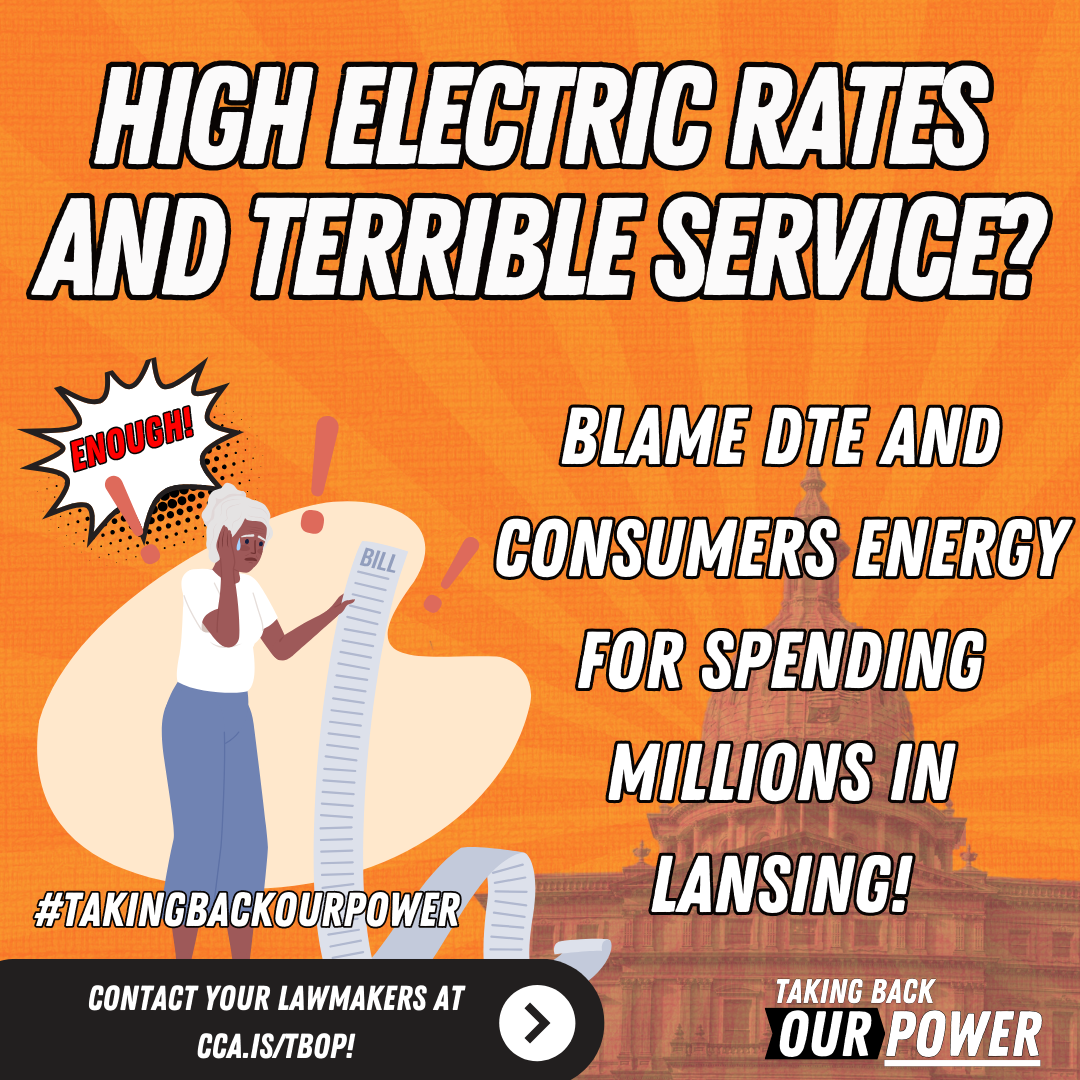
          Currently, Michiganders pay the highest electric rates for the second worst power outages in the Midwest because monopoly corporations like DTE and Consumers Energy have spent millions in state political contributions to escape accountability for poor service and high energy bills.

          Whether you’re a homeowner constantly worrying about power outages or a business owner grappling with a high Consumers Energy bill or DTE bill, the struggle is real and shared by many across the state. Here’s why it’s happening — and what you can do.

          The Causes of Michigan’s Power Outage Woes

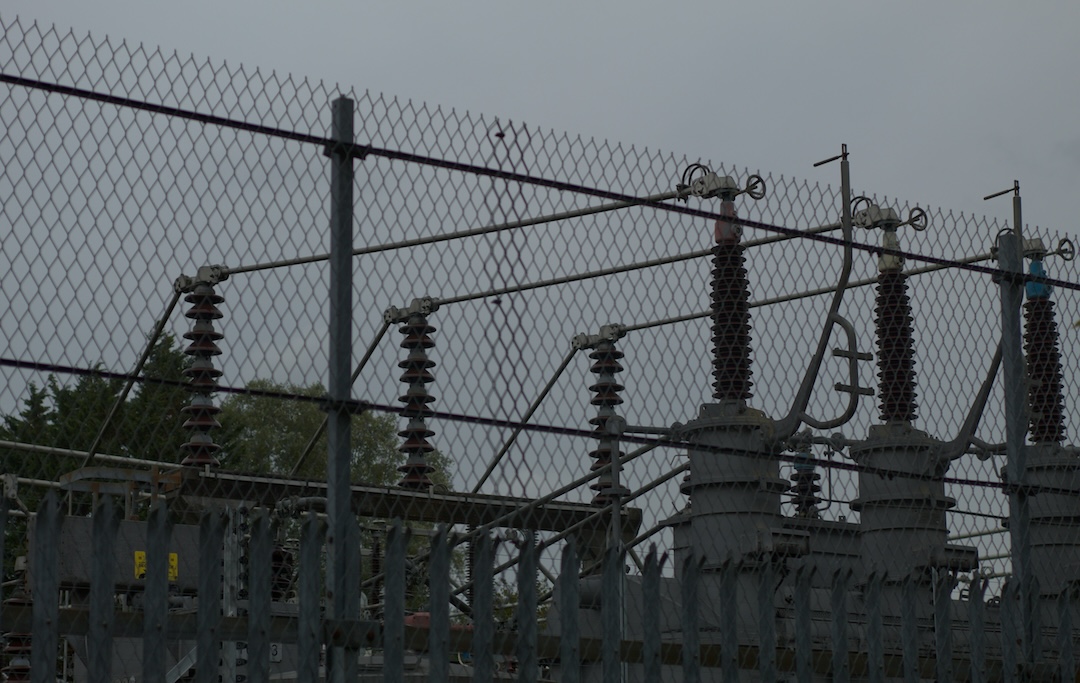
          The abnormally high rate of Michigan power outages is an all-too-familiar sore spot for its residents. The state ranks second nationwide for the number of power disruptions per year, and it’s the fourth worst state for power loss duration. In general, electric outages are most often caused by severe weather, and the entire Midwest is known for its punch-packing thunderstorms, snowstorms, and ice. 

          However, neighboring Midwestern states with similar weather patterns have fewer outages and faster power restoration times. Several factors contribute to this disparity:

          • Aging infrastructure. Michigan’s electrical grid is outdated and often struggles to keep up with modern demands. Many components of the grid are decades old, making them prone to failures.

          • Inadequate power loss prevention. According to ratepayer advocates, major utility companies in Michigan — namely, DTE Energy and Consumers Energy — consistently neglect to execute adequate outage prevention strategies, like maintaining the electric grid and trimming trees near power lines.

          • Increasingly extreme weather patterns. Global warming and the current climate crisis have been causing more frequent and destructive weather events, placing additional strain on an already-fragile infrastructure.

          These outages not only disrupt daily life, but can also lead to significant economic losses, particularly for small businesses that rely heavily on consistent power supply.

          Why Electric Bills Are So High in Michigan

          In addition to having more frequent and longer-lasting power disruptions than other Midwestern states, Michigan residents also pay some of the highest electricity rates in the region. The average electric bill in Michigan is several cents higher per kilowatt hour than in states like Ohio, Illinois, and Indiana. Several factors contribute to these high costs:

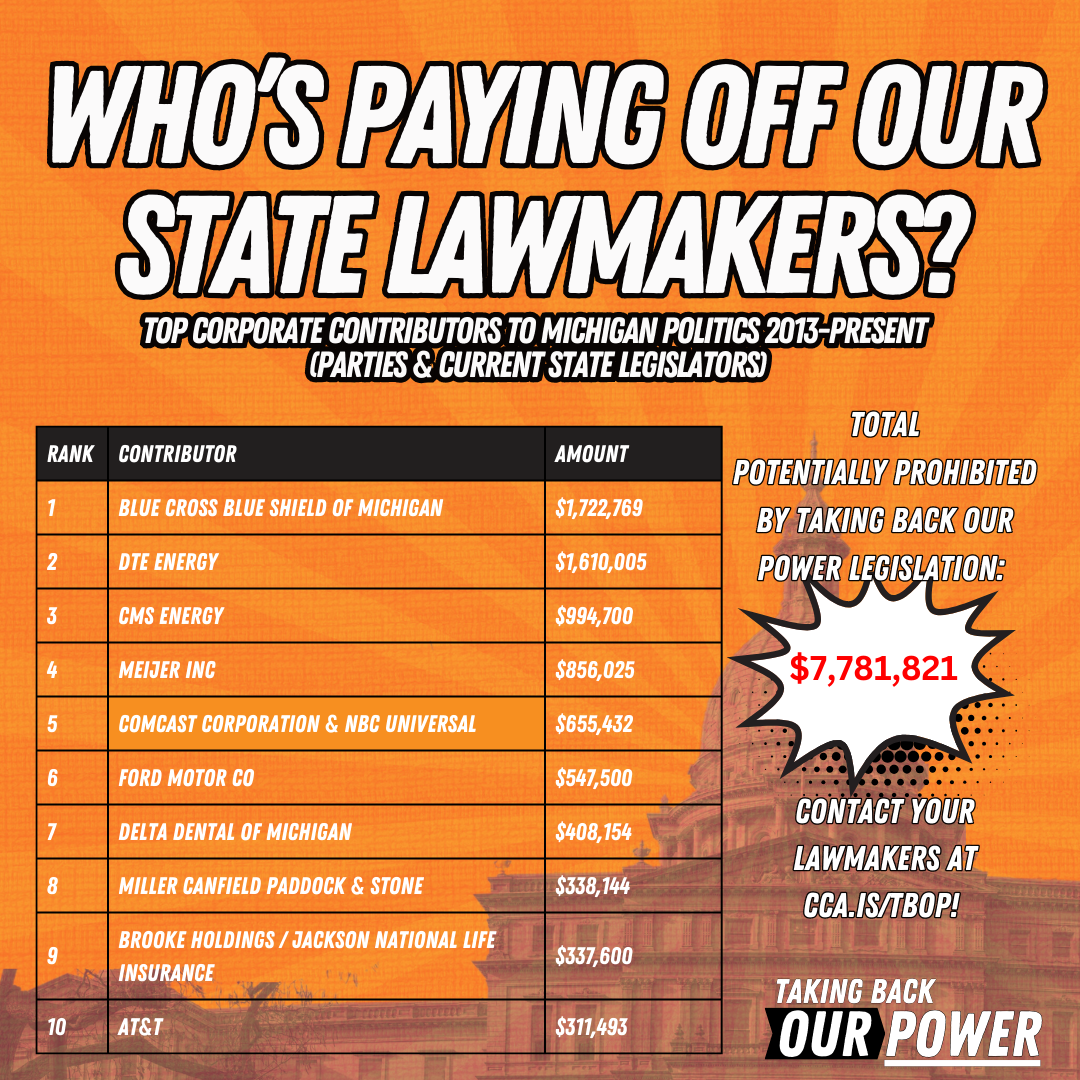
          • Corrupt political influence. DTE Energy and Consumers Energy enjoy strong political influence through their substantial donations to lawmakers. These totaled almost $500,000 in 2023, and over 80% of the state legislating body accepted contributions from these corporations that year. This practice leads to profitable regulatory decisions for energy companies at the expense of consumers. Further, because they are regional monopolies, consumers can’t choose to switch to a competitor.

          • High operational costs. High costs associated with maintaining aging infrastructure and making investments in new components and technologies are often passed on to consumers, especially if regulatory bodies allow this to happen.

          • Approval of rate increases. The Michigan Public Service Commission (MPSC) has approved multiple rate increases for utility companies. For example, Consumers Energy was recently granted a $92 million rate increase.

          These factors combine to create a disproportionate financial burden on residents and small businesses, making it difficult for many to manage their monthly energy expenses.

          How Michiganders Can Take Back Their Power

          While these challenges are complex, there are relatively simple steps that Michiganders can take to get better continuity and pricing when it comes to electricity. 

          Start by Taking Back Your Right to Affordable Energy

          It doesn’t have to be this way. Join us in urging state lawmakers to sign the Taking Back Our Power Pledge. The program, a collaboration with our sister organization Michigan United Action and six other organizations, advocates for a bill that would prohibit regulated monopoly corporations and government contract-seeking corporations from making state or local political contributions.

          미시간 유나이티드 is a broad, statewide coalition working to reform our broken healthcare and immigration systems, protect our environment, end mass incarceration, and make essential services accessible to all. We are steadfast in our belief that all of us suffer when corporations have undue influence over the elected officials who are supposed to be looking out for us.

          Speak Up and Take Action 

          Engage with social justice-related nonprofits and policymakers to push for regulatory reforms that prioritize consumer interests over utility company profits. You can do this conveniently and effectively through the Taking Back Our Power campaign, which seeks to ban regulated monopoly corporations from contributing to political funds in order to gain lucrative government contracts.

          Increase Your Energy Efficiency 

          Implementing energy-efficient practices and technologies can help reduce consumption and lower bills. Green banks like Michigan Saves publish tips for saving energy and offer affordable financing for eligible energy-efficient home and business upgrades. 

          Participate in Utility Incentive Programs

          Utility companies — yes, even DTE Energy and Consumers Energy — offer consumer rebate and discount programs for qualifying energy-efficient purchases. Find out if you can take advantage of these and take back some of your energy bill budget.

          Support Clean Energy Initiatives

          Advocate and vote for clean energy initiatives and laws. These make sustainable energy more accessible for lower-income communities. They also work to hold utility companies accountable for initiatives like implementing affordable solar energy, electric waste reduction, and energy-efficient retrofittings for homes and businesses.  

          While the road to fair and reliable electricity service is challenging, collective action and informed decision-making can pave the way for meaningful improvements. By taking these steps, Michiganders can achieve a more equitable, affordable, and sustainable energy future. 

          지금 무언가를 할 준비가 되셨나요?

          저희 프로젝트에 참여하세요!
          Join “Taking Back our Power” and take a stand against money in Michigan politics

          우리는 규제를 받는 독점 기업과 정부 계약을 원하는 기업이 정치 기부를 하지 못하도록 하는 포괄적인 주 법안을 통과시키기 위해 싸우는 미시간의 노동자 가족 연합입니다. 우리는 더 이상 그들이 책임을 회피하고 국민의 목소리를 외면하도록 내버려둘 수 없습니다!

          JOIN

          Join “Care Over Cost” and help us get people the healthcare coverage promised by their insurers

          In Michigan and all across the country, our members are fighting individual care denials and are WINNING people the care they need–and paid fo! Together, we are working to transform our health care system to put Care Over Cost and people over profit.

          JOIN

          Become a Relational Organizer

          Relational organizing is defined as “preparing & supporting people to bring the power within their existing relationships to affect change.” In actuality is it turning a contact into a conversation and then into a person empowered to create change where they live.

          JOIN

          최근 뉴스 및 미디어

          '}}
          자세히 보기

          Don’t Miss Events

          함께,  

          우리는 변화를 만들 수 있습니다

          기부하기
          이메일 목록에 가입하기

          미시간 유나이티드

          우리는 미시간 전역의 노동, 기업, 사회 서비스 및 민권 단체의 연합으로 주택 소유자, 세입자, 이민자 가족 및 학생의 권리를 위해 싸우고 있습니다.

          미시간 유나이티드는 501c(3) 비영리 단체입니다.

          기부금은 세금 공제 대상입니다.

          전화 문의 1-877-507-7774

          작성일자 9월 4, 20243월 13, 2026글쓴이 dasbates카테고리 블로그, 뉴스 및 미디어, 주 전체, 우리의 힘을 되찾다태그 Civic Engagement
          우리의 권력을 되찾기 위한 10가지 질문

          우리의 권력을 되찾기 위한 10가지 질문

          뉴스 및 미디어


          Download & Share

          Facebook
          트위터

          How can we stop monopoly corporations and powerful government contractors from drowning out the voice of the people?

          Because government contractors and regulated monopoly corporations have such direct incentives to buy their way out of accountability and corrode the public trust, the federal government, the Securities and Exchange Commission, and 15 US states require some form of limits on political contributions from government contractors and/or monopoly corporations. The State of Michigan has enacted this type of law before, and Federal Courts have affirmed that states are allowed to prohibit most or all political contributions to legislators and parties from corporate-controlled entities, company principals (including spouses and close family), and lobbyists of regulated monopolies or companies that contract with government entities.

          Are my constituents supportive of Legislation to Take Back Our Power?

          Yes, overwhelmingly, according to polling results released by Progress Michigan and Public Policy Polling. The survey found that 67% of respondents favor banning political contributions from regulated monopolies and corporations seeking government contracts. Support for this initiative surged to 76% when respondents were informed that regulated monopolies, such as DTE Energy and Consumers Energy, have used their disproportionate influence in Lansing to escape accountability and create the political context in which Michiganders now pay the highest electric rates in the Midwest for the worst power outages. Additionally, the survey found that there are major upsides for elected officials that support this initiative with almost no downside as 54% of respondents indicated they would be more likely to vote for a candidate who advocates for banning political contributions from these entities, while only 8% would be less likely.

          What would a law to take back our power look like in Michigan?

          The Taking Back Our Power coalition is advocating for Michigan legislation that limits the controlled entities and principals of regulated monopoly corporations and sizeable government contractors at the state, county, and local levels, from making contributions to: 1) state or local candidate committees; 2) PACs/Super PACs; 3) dark money 501(c)(4) groups controlled by candidates or affiliated with regulated monopoly corporations or government contractors; and 4) state or local party committees.

          House Bills 5520, 5521, and a forthcoming bill currently in process with the Legislative Services Bureau achieve this as it pertains to regulated monopoly corporations and are endorsed by the Taking Back Our Power coalition. Our coalition is working to introduce companion legislation applying the same prohibitions on corporations seeking government contracts. The prohibitions would apply to contractors with $250,000 or more in aggregate contract awards, and would cover a period of 18 months before seeking or entering the contract, during the term of the contract, and 18 months after the termination of the contract. To comprehensively protect our democracy from corporations that directly profit from outsized influence over elected officials, the Taking Back Our Power coalition is advocating that both the utility-side and contractor-side bills be tie-barred together.

          What entities would be impacted by this legislation?

          With some exceptions (see below on recipients of grants, cities, counties, and public universities), the entities in this state-maintained list of vendors that receive government contracts through a procurement process would be affected by this legislation. Municipalities would have their own lists as well. In Michigan, state regulated monopolies that fall under the authority of the Michigan Public Service Commission like DTE, Consumers Energy, and International Transmission Co. would also fall under the prohibition.

          Because money is fungible, and to preserve voters’ faith in our democracy, it is important to close all loopholes available to these companies. Drawing from language in other state laws, as well as court opinions affirming these laws, the Taking Back Our Power coalition is advocating that Michigan legislation should include principals of these companies, including: the CEO or comparable officer; any member of the board of directors, or an individual who has an ownership interest of five per cent or more in the contractor; employees who are a president, treasurer, vice president, or officer; any employee who has managerial or discretionary responsibilities with respect to government affairs or a government contract; the spouse or a dependent child of an individual described in this section; a political committee (e.g. PAC) established or controlled by an individual described in this section or the business entity or nonprofit organization that is the state contractor or prospective state contractor; lobbying firms, their families, and PACs associated with these firms or their families; any subsidiaries directly or indirectly controlled by the contractor or prospective contractor; or by anyone acting on behalf of the individuals, funds, or entities described in this section. States that have taken half measures to address pay-to-play corruption have seen scandals that show us the need to close these loopholes (eg, Hawaii, Georgia, North Carolina). 

          What about recipients of grants?

          No. Recipients of public grants do not go through the procurement process and are not included in the definition of government contractors or monopoly corporations. 

          What about cities, counties, and public universities?

          No. Cities, counties, and public universities are governed by elected officials and would be excluded in the legislation.

          Are lobbying, legal, or consulting firms affected?

          The legislation we are advocating for would not impact lobbying, legal, or consulting activities or the hiring of such firms. We recognize these firms often do important work. The legislation would only stop such firms from making political contributions that could create the appearance of “buying” contracts or more favorable terms for themselves or their clients (contributions made before the law is enacted would not be considered). In other words, the legislation would allow hired firms to lobby and communicate their clients’ interests and policy perspectives to elected decision-makers, but hired firms would not be allowed to serve as a vehicle for wielding financial leverage on behalf of their clients while they’re doing it. This is an important provision that has been adopted in other jurisdictions and affirmed by federal courts because powerful companies have used lobbying pass-throughs to circumvent ethics laws. See this article for an example where Troutman Sanders, a law firm working for Georgia Power, allegedly served as a pass-through entity on behalf of their client. And in North Carolina, where registered lobbyists are prohibited from making campaign contributions, lobbyists are openly sidestepping the law by routing large donations through spouses and other employees at their firms.

          Who monitors compliance?

          The onus for compliance is on the companies and the procurement or regulatory authority. For example, if the state procurement office or Michigan Public Service Commission (MPSC) finds that a company has violated the rules, they can enter into a remedy process with the company. Candidates are not expected to monitor the activities of principals of corporations seeking state contracts or companies regulated by the MPSC and, under the proposed legislation, will not be involved in that process. 

          Would this legislation have mitigated the Lee Chatfield corruption scandal?

          Yes. The most scandalous part of what has been revealed by AG Nessel’s Lee Chatfield investigation is how companies like DTE and Consumers Energy were allowed to deposit $80,000 to Chatfield’s 501(c)(4) organization, which was legally usable for Chatfield’s lavish travel and lifestyle. Nessel issued a challenge to the legislature on the need to reform our inadequate campaign finance laws, which this legislation addresses.

          Who is in the Taking Back Our Power Coalition?

          The Taking Back Our Power coalition currently includes Clean Water Action, Community Change Action, Detroit Action, Detroit Jews for Justice, Emergent Justice, Michigan Environmental Justice Coalition, Michigan League of Conservation Voters, Michigan United Action, MOSES Action, and Voters Not Politicians.  

          FEATURES & SERVICES

          What could happen if we organize 3.5% of Michigan?

          Project 3.5 is our plan to organize 3.5% of Michigan, tear down the barriers of inequality

          and replace what remains with dignity and opportunity.

          To accomplish this, we need motivated people ready to lead with effort and dollars.

          This is your chance to become the leader you’ve always wanted to see.

          Join our movement with an affordable monthly membership plan.

          Join

          Check out the coolest membership t-shirt ever

          $25/MONTH

          Join with a friend

          A member t-shirt for you

          and your friend.

          $40/MONTH

          Give what you can

          YOU DECIDE

          지금 무언가를 할 준비가 되셨나요?

          저희 프로젝트에 참여하세요!

          Join “Taking Back our Power” and take a stand against money in Michigan politics

          우리는 규제를 받는 독점 기업과 정부 계약을 원하는 기업이 정치 기부를 하지 못하도록 하는 포괄적인 주 법안을 통과시키기 위해 싸우는 미시간의 노동자 가족 연합입니다. 우리는 더 이상 그들이 책임을 회피하고 국민의 목소리를 외면하도록 내버려둘 수 없습니다!

          JOIN

          Join “Care Over Cost” and help us get people the healthcare coverage promised by their insurers

          In Michigan and all across the country, our members are fighting individual care denials and are WINNING people the care they need–and paid fo! Together, we are working to transform our health care system to put Care Over Cost and people over profit.

          JOIN

          Become a Relational Organizer

          Relational organizing is defined as “preparing & supporting people to bring the power within their existing relationships to affect change.” In actuality is it turning a contact into a conversation and then into a person empowered to create change where they live.

          JOIN

          최근 뉴스 및 미디어

          '}}
          자세히 보기

          작성일자 7월 17, 20243월 13, 2026글쓴이 dasbates카테고리 블로그, 환경 정의, 운동 정치, 주 전체, 우리의 힘을 되찾다태그 Civic Engagement, 우리의 힘을 되찾다

          글 페이지 매김

          이전 쪽 페이지 1 ... 페이지 6 페이지 7
          Proudly powered by WordPress
          We've detected you might be speaking a different language. Do you want to change to:
          Change language to English English
          Change language to English English
          Change language to Spanish Spanish
          Change language to Arabic Arabic
          Change language to Chinese Chinese
          Korean
          Change language to Vietnamese Vietnamese
          Change language to Bengali Bengali
          Change language to Urdu Urdu
          Change language to Tagalog Tagalog
          Change language to Hindi Hindi
          Change Language
          Close and do not switch language
          Korean
          English Spanish Arabic Chinese Vietnamese Bengali Urdu Tagalog Hindi